Has Inheritage Foundation supported you today?
Your contribution helps preserve India's ancient temples, languages, and cultural heritage. Every rupee makes a difference.
Secure payment • Instant 80G certificate
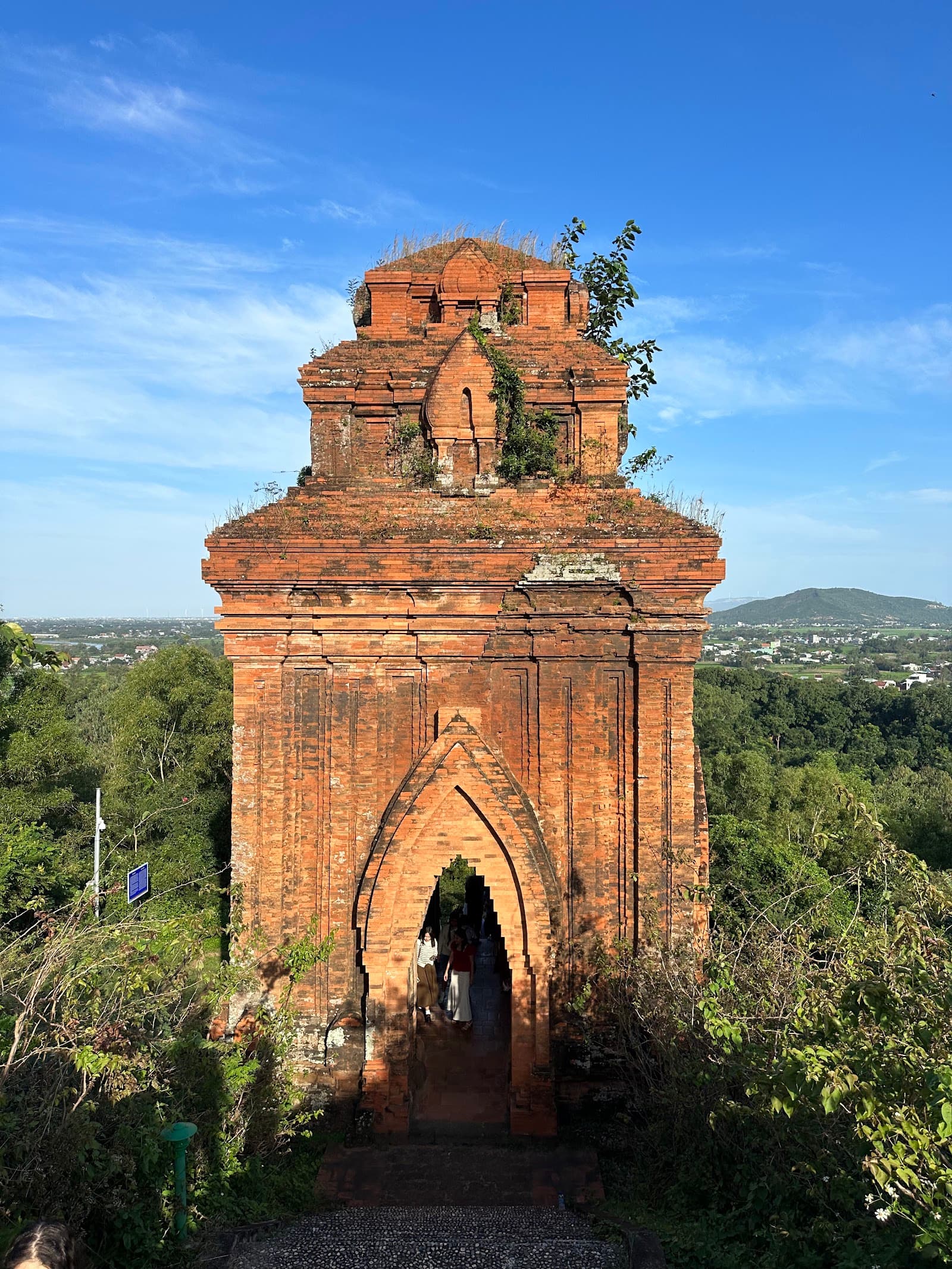
Thap Banh It Silver Towers Binh Dinh Vietnam
Thap Banh It, also known as the Silver Towers, dramatically situated on a hilltop in Binh Dinh Province, Vietnam, represents one of the most visually striking and architecturally sophisticated Cham Hindu temple complexes in Vietnam, constructed in the late 11th century CE during the height of Champa power, comprising four towers arranged in a distinctive configuration that demonstrates the continued transmission of Indian Hindu religious and architectural traditions to Southeast Asia. The temple complex, featuring a main tower dedicated to Shiva standing at 22 meters tall, along with three smaller towers arranged around it, showcases extraordinary red brick structures adorned with intricate sandstone carvings and bas-reliefs that demonstrate the sophisticated synthesis of Indian Hindu temple architecture, particularly the Dravidian traditions of southern India, with indigenous Cham building techniques, creating a unique architectural expression that reflects Champa's deep engagement with Indian religious and cultural traditions. The main tower, dedicated to Shiva, features elaborate decorative programs including bas-reliefs depicting Hindu deities, mythological scenes, and Cham royal iconography that demonstrate the direct transmission of Indian Hindu iconography and artistic traditions, while the discovery of Sanskrit inscriptions provides crucial evidence of the site's role as a center for the transmission of Indian religious texts and practices to Southeast Asia. The site's location on a prominent hilltop, chosen according to Indian cosmological principles emphasizing the connection between earth and sky, underscores its spiritual significance as a place where the divine and earthly realms intersected, while the complex's distinctive configuration, with towers arranged to create a harmonious architectural composition, demonstrates the sophisticated understanding of Indian temple planning principles possessed by Cham architects. Archaeological evidence reveals that the complex served as a major center of Hindu worship for the Champa Kingdom, attracting devotees from across the region, while the site's excellent preservation provides crucial insights into the sophisticated engineering and artistic techniques employed in Cham temple construction, including the unique Cham method of firing bricks in situ and the use of sandstone for decorative elements. The towers feature distinctive Cham architectural elements including tiered pyramidal roofs, elaborate false doors, and extensive decorative programs that demonstrate the adaptation of Indian temple architecture to local materials and aesthetic preferences, while the site's prominent hilltop location offers panoramic views of the surrounding countryside, adding to its spiritual and aesthetic appeal. Today, Thap Banh It stands as one of the most important Cham Hindu temples in Vietnam, serving as a powerful testament to the transmission of Indian Hindu culture and architecture to Southeast Asia, while the site's excellent preservation and prominent location ensure its ongoing significance as both a cultural monument and a testament to the enduring legacy of Indian-Cham cultural exchange. ([1][2])
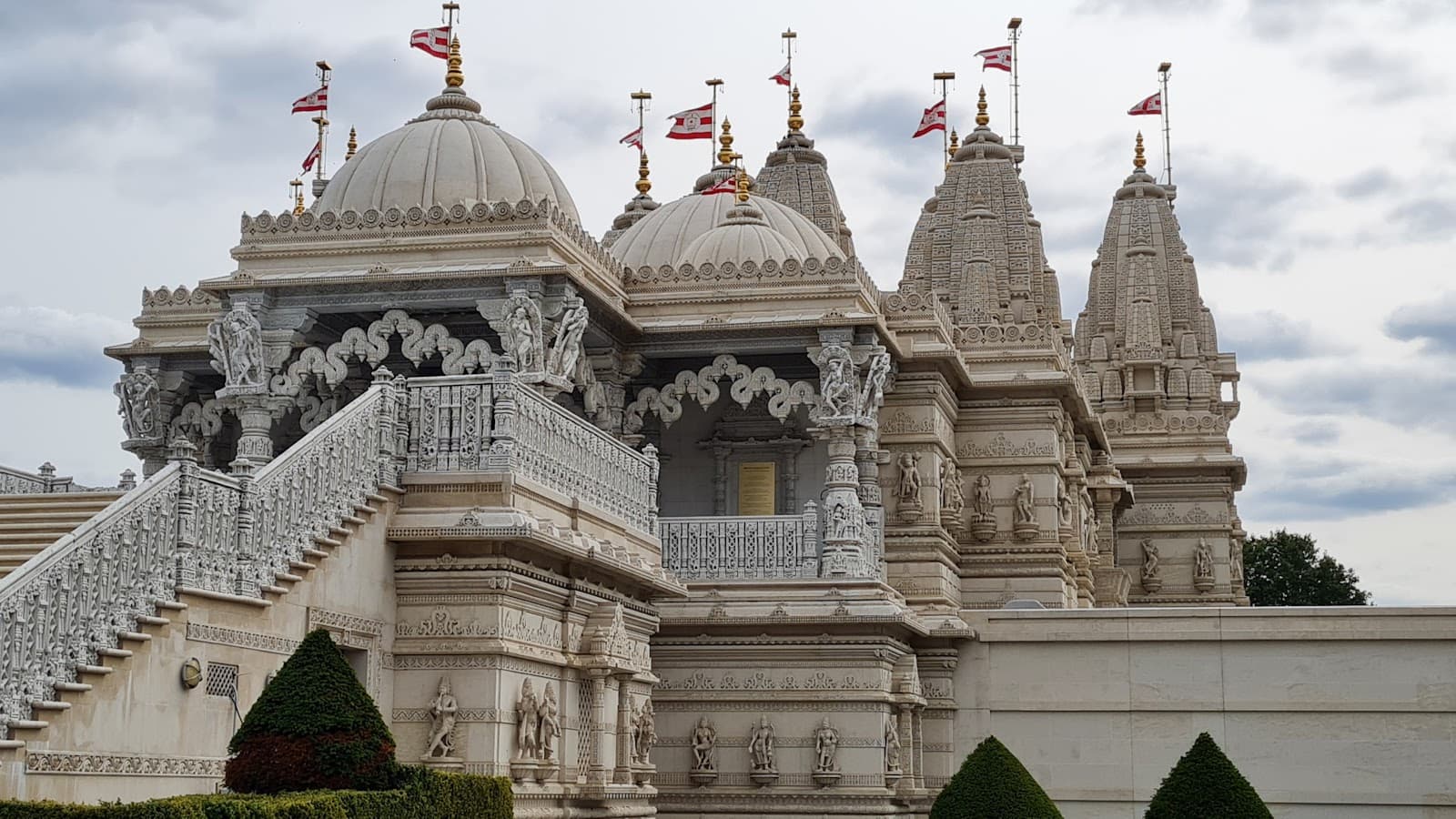
BAPS Shri Swaminarayan Mandir London
Rising from the residential area of Neasden, the BAPS Shri Swaminarayan Mandir London stands as a testament to traditional Nagara-style architecture, inaugurated in August 1995 by Pramukh Swami Maharaj ([1][2]). Daily darshan (viewing of the deity) occurs between 9:00 AM and 12:00 PM, and again from 4:00 PM to 6:00 PM, with midday arti (worship ceremony) at 11:45 AM and evening arti at 5:15 PM, drawing devotees beneath its intricately carved domes ([1]). Volunteers diligently manage shoe storage, queues, and security screenings ([1]). Intricate carvings adorning the walls reflect the aesthetic principles detailed in texts such as the *Shilpa Shastras*, which outline the proportions and ornamentation of sacred structures ([3]). While further research is needed to identify specific textual references, Vastu Shastra principles, the ancient Indian science of architecture, likely influenced the temple's layout and orientation, aligning it with cosmic energies ([4]). Adjoining the Mandir is the Haveli cultural complex, which features a 3,000-seat assembly hall, classrooms, a dining hall, and the award-winning “Understanding Hinduism” exhibition, which welcomes school groups and interfaith delegations seven days a week ([1]). Granite and sandstone blocks, meticulously carved, evoke ancient Indian temple construction methods ([5]). The temple complex provides visitor services such as information desks, guided tours, a bookshop, and a café, and broadcasts puja (prayer) and cultural events worldwide via the BAPS media platform ([1]). Furthermore, the Mandir actively engages in daily annadhanam (food offering), blood donation drives, health screenings, and food relief missions in coordination with Brent Council ([1][6]). Copper Kalashas (Finials) crown the structure, while the expansive piazza serves as a civic gathering place during Diwali, Janmashtami, and Children’s Diwali on Trafalgar Square rehearsals ([1]). The temple's construction utilized Turkish Limestone, Italian Carrara Marble, and English Oak alongside structural concrete and a glass curtainwall ([1]).
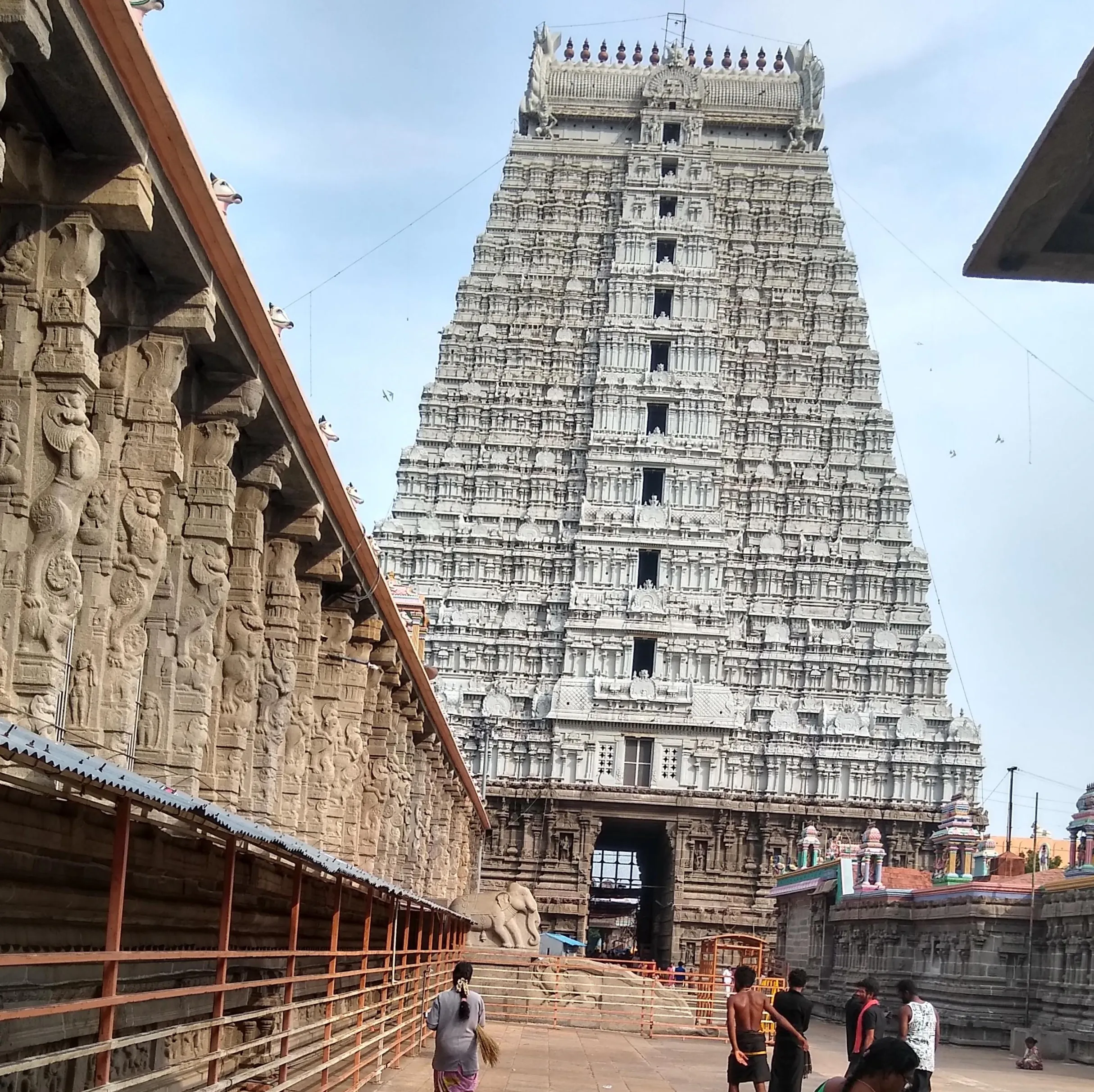
Arunachaleswarar Temple Tiruvannamalai
The colossal gopurams of Arunachaleswarar Temple in Tiruvannamalai dominate the landscape, a testament to Dravidian temple architecture ([1]). Approaching the temple, the sheer scale is striking, with nine towering gopurams intricately sculpted with deities ([2][3]). The Rajagopuram, an 11-tiered eastern gateway, exemplifies the temple's grandeur and serves as the primary entrance ([4]). Intricate carvings adorning the walls depict scenes from Hindu mythology, showcasing the artistic skills of the artisans who worked on the temple ([5]). Within the Garbhagriha (Sanctum), the lingam representing Shiva is the focal point of devotion, drawing devotees from far and wide ([6]). The temple, built around 850 CE during the Chola period, reflects the dynasty's patronage of art and architecture ([7][8]). Granite and sandstone blocks, meticulously carved, form the structural components of this sacred space ([9]). During the Chola period, temple architecture reached new heights, with an emphasis on elaborate ornamentation and towering structures ([10]). Vastu Shastra principles, the ancient Indian science of architecture, likely guided the temple's layout and design, ensuring harmony and balance ([11]). The thousand-pillared hall, or Mandapa (Pillared Hall), displays geometric patterns, a contrast to the figurative sculptures found elsewhere ([12]). The Kambathu Amman Sannadhi, dedicated to Parvati, offers a serene space for contemplation and prayer ([13]). Circling the temple on the Girivalam path reinforces the temple's spiritual significance, a practice deeply rooted in Hindu tradition ([14]). The walls of the temple serve as a canvas of history, with inscriptions in ancient Tamil script and architectural additions from various dynasties ([15]). These inscriptions provide valuable insights into the temple's history and the socio-cultural context of the time ([16]). Arunachaleswarar Temple embodies the artistic genius of Dravidian architecture, a legacy that continues to inspire awe and reverence ([17]).
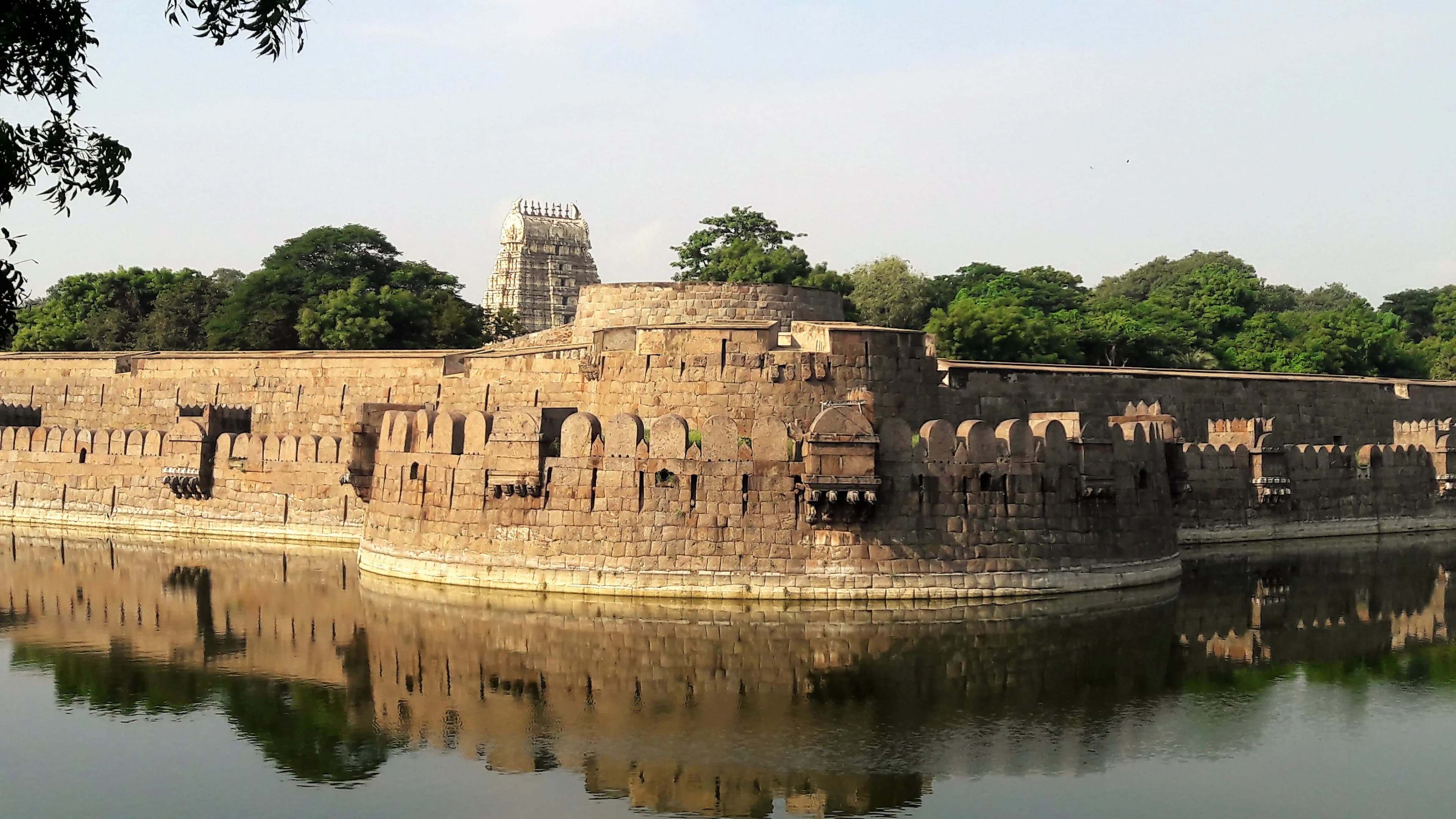
Vellore Fort Vellore
The imposing granite ramparts of the Vellore Fort rose before me, shimmering under the Tamil Nadu sun. Having explored the intricate stone carvings of Gujarat's architectural wonders, I was eager to experience the distinct Dravidian style of this 16th-century marvel. The sheer scale of the fort, its moat still brimming with water, immediately impressed. This wasn't just a military stronghold; it was a statement of power etched in stone and earth. Crossing the sturdy bridge over the moat, I felt a palpable shift in atmosphere. The outside world faded, replaced by the hushed grandeur of history. The main entrance, the Bali Kota, was a formidable gateway, its thick wooden doors reinforced with iron. The architecture here, unlike the ornate carvings I was accustomed to back home, was characterized by robust functionality. The emphasis was on strength and defense, a stark contrast to the celebratory nature of many Gujarati temples. Inside, the fort unfolded like a layered narrative. The Jalakanteswara Temple, nestled within the fort's walls, was a breathtaking example of Vijayanagara architecture. The intricate carvings covering the gopuram, though weathered by time, were a testament to the skill of the artisans. I spent a considerable amount of time studying the depictions of deities and celestial beings, noting the distinct stylistic differences from the iconography found in Gujarat's temples. The temple's location within the fort itself spoke volumes about the intertwined nature of religion and power during that era. My exploration led me to the Kalyan Mahal, a palace within the fort. Here, the architectural style shifted again. While the base retained the robust granite construction, the upper levels displayed delicate arches and balconies, hinting at Mughal influences that seeped in later centuries. Peering through the arched windows, I imagined the lives of those who once resided within these walls – royalty, soldiers, and perhaps even artists who adorned the temple with its intricate carvings. One of the most striking features of the Vellore Fort is its moat. Unlike many dry moats I've encountered, this one was filled with water, creating a formidable natural barrier. I learned that crocodiles were once introduced into the moat as an added layer of defense, a detail that sent a shiver down my spine. Circling the fort along the ramparts, I could appreciate the strategic brilliance of its design. The high walls, the wide moat, and the strategically placed bastions offered a panoramic view of the surrounding plains, allowing defenders to anticipate any approaching threat. Descending into the dark, damp cellars known as the Tipu Mahal, I felt a palpable sense of history. These underground chambers, once used for storage and perhaps even as prisons, offered a glimpse into the less glamorous aspects of fort life. The air was thick with the scent of damp earth and the echoes of the past seemed to linger in the silence. As I left the Vellore Fort, the late afternoon sun casting long shadows across the ramparts, I carried with me a deeper understanding of South Indian military architecture. The fort was not merely a collection of stones and mortar; it was a living testament to the ingenuity and resilience of those who built and defended it. The experience was a powerful reminder that architecture, at its best, can tell a story, and the Vellore Fort had whispered its tales to me in a language both powerful and profound. The contrast with the architectural traditions of my home state, Gujarat, only served to enrich my appreciation for the diversity and richness of India's architectural heritage.
Laxmi Vilas Palace Vadodara
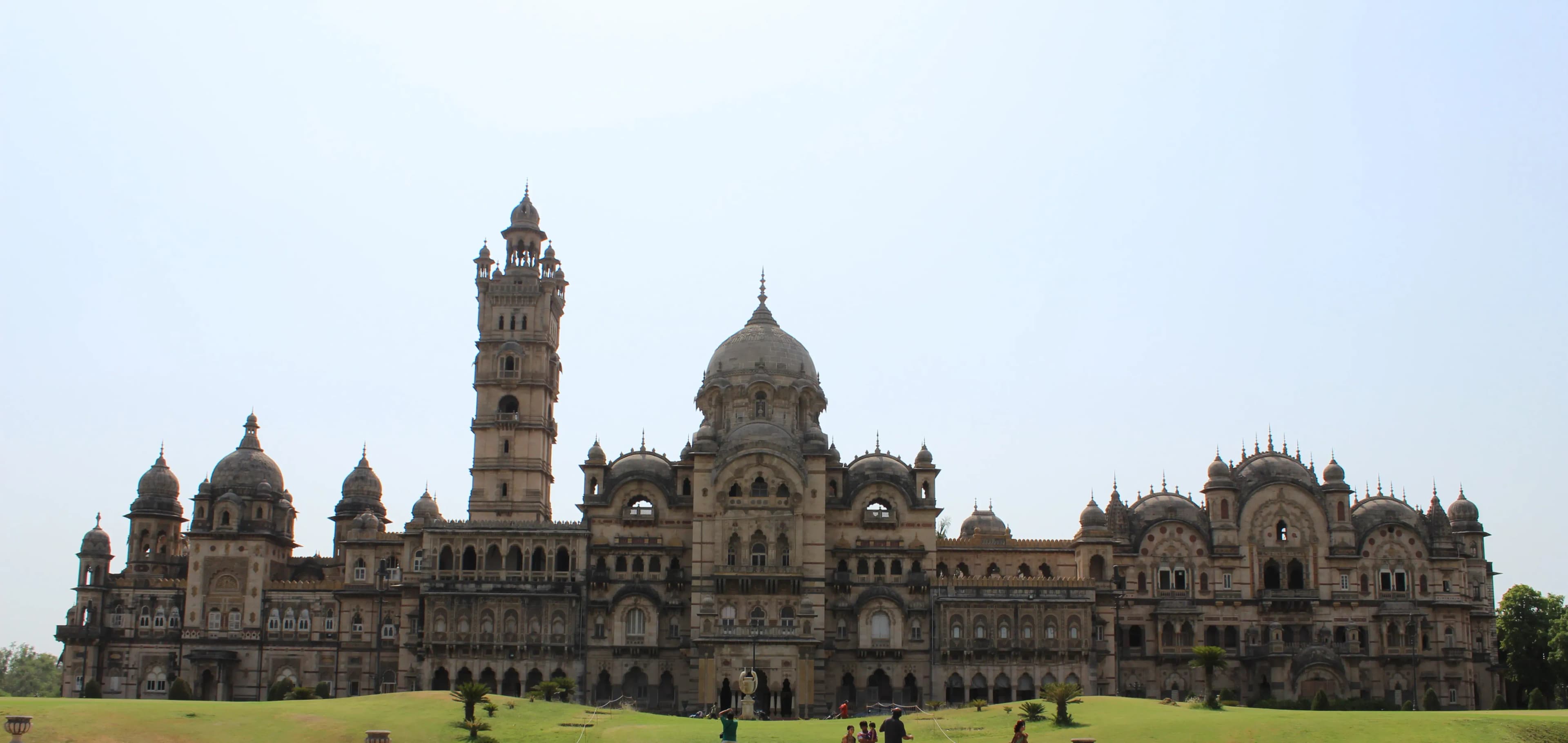
The wrought iron gates of Laxmi Vilas Palace, embellished with the Gaekwad coat of arms, seemed to whisper tales of a bygone era as I stepped onto the sprawling grounds. This wasn't merely a palace; it was a statement – a testament to the grandeur and vision of Maharaja Sayajirao Gaekwad III. The sheer scale of the Indo-Saracenic structure, dwarfing even the impressive structures I’m accustomed to in Kolkata, left me momentarily speechless. Built in 1890, it remains the largest private dwelling in India, four times the size of Buckingham Palace, a fact that continually echoed in my mind as I explored its vast expanse. The first thing that struck me was the seamless blend of architectural styles. While the domes and arches spoke of Mughal influence, the intricate carvings and jalis (perforated stone screens) were distinctly Gujarati. The use of European architectural elements, such as the Italian marble columns and stained-glass windows, added another layer of complexity, showcasing the Maharaja's cosmopolitan outlook. It wasn't just a fusion of styles, but a conversation between them, each element complementing the other in a harmonious symphony of stone and artistry. Inside, the Durbar Hall, with its Venetian mosaic floors and Belgian stained-glass windows depicting scenes from the Mahabharata, was breathtaking. The sheer opulence was almost overwhelming, yet there was a sense of restraint, a refusal to descend into gaudiness. The delicate floral motifs carved into the sandstone walls, the intricate chandeliers hanging from the high ceilings, and the portraits of the Gaekwad dynasty lining the walls all spoke of a refined aesthetic sensibility. I was particularly fascinated by the Navlakhi stepwell, tucked away in a corner of the vast gardens. Descending into its cool depths, I felt transported back in time. The intricate carvings on the stepwell walls, depicting deities and celestial beings, were remarkably well-preserved, a testament to the quality of the craftsmanship. It was a space of quiet contemplation, a stark contrast to the grandeur of the palace itself. The palace museum, housed within a section of the main building, provided a fascinating glimpse into the lives of the Gaekwad rulers. The collection of weaponry, including swords, guns, and armor, was impressive, but it was the personal artifacts – the Maharaja's vintage cars, his collection of clocks, and the portraits of his family – that truly captured my attention. These objects humanized the Maharaja, transforming him from a historical figure into a man with passions and interests. As I wandered through the manicured gardens, past fountains and sculptures, I couldn't help but reflect on the legacy of Maharaja Sayajirao Gaekwad III. He was not just a builder of palaces, but a visionary ruler who invested heavily in education, infrastructure, and social reforms. Laxmi Vilas Palace, therefore, is not just a symbol of his wealth, but a reflection of his progressive ideals. The palace continues to be the residence of the royal family, a living testament to a dynasty that shaped the history of Vadodara. Leaving the palace grounds, I felt a sense of awe and gratitude. Awe at the sheer magnificence of the structure and the artistry of its creators, and gratitude for the opportunity to witness a piece of history firsthand. Laxmi Vilas Palace is not just a building; it is a story etched in stone, a story of ambition, vision, and a deep appreciation for beauty. It is a must-see for anyone interested in Indian architecture and history, a place where the past comes alive in all its splendor.
Bhadrachalam Temple Bhadrachalam
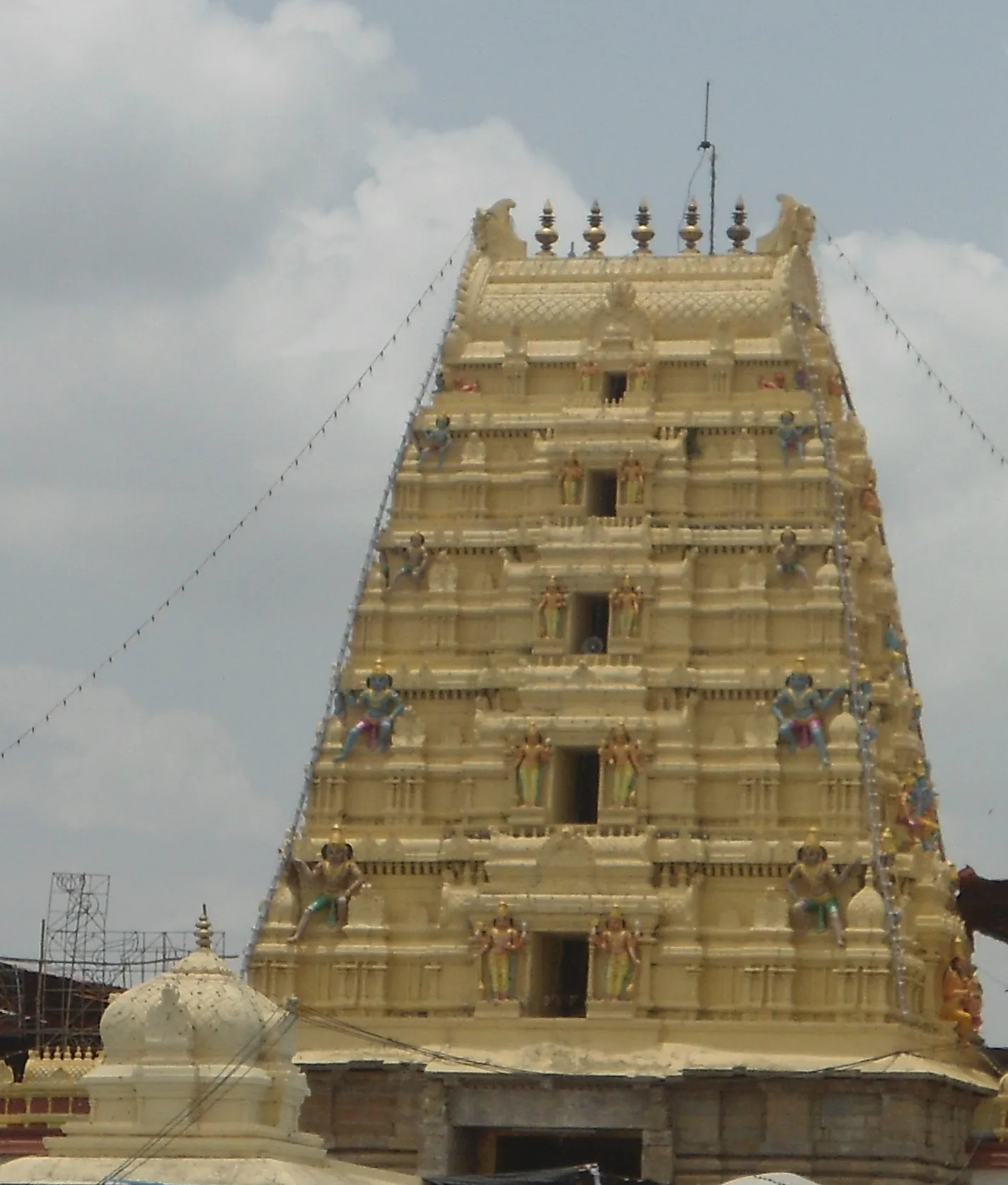
Along the Godavari's banks, the Sri Sita Ramachandra Swamy Temple at Bhadrachalam narrates tales of devotion from its perch on a small hillock ([1]). During the Nayaka period, specifically in 1674 CE, this sacred edifice was constructed ([2]). The temple embodies the Dravidian style, characterized by intricate carvings and a pyramidal gopuram (tower) ([3]). Kancherla Gopanna, also known as Ramadasu, a fervent 17th-century devotee, built the temple during the Golconda Sultanate's rule, leaving an indelible mark of his artistic vision ([4]). Granite and sandstone blocks, meticulously carved, form the temple's structure, demonstrating the architectural skills of the time ([5]). Intricate carvings adorning the walls depict deities and scenes from Hindu mythology, reflecting ancient artistry ([6]). The pyramidal gopuram (tower), a prominent feature, displays detailed sculptures that evoke a sense of dynamism and spiritual ascent ([7]). Polished stone floors within reflect light, enhancing the beauty of the intricately carved pillars, which narrate episodes from the Ramayana ([8]). These pillars showcase a harmonious blend of celestial beings and floral motifs ([9]). Within the Garbhagriha (Sanctum), Lord Rama, Sita, and Lakshmana reside, emanating serenity amidst fervent devotion ([10]). Smaller shrines, each with distinct architectural nuances, dot the courtyard, dedicated to various deities ([11]). Ramadasu's unwavering faith and artistic brilliance are deeply intertwined with the temple's history, resonating in every stone and carving ([4]). Bhadrachalam transcends being merely a structure; it represents a confluence of history, faith, and artistic expression ([1][3]). The temple stands as a testament to the enduring legacy of devotion and architectural grandeur in the Telangana region ([2]).

Sarveshwar Mahadev Temple Kurukshetra
The late afternoon sun cast long shadows across the Kurukshetra battlefield, imbuing the landscape with a palpable sense of history. But it wasn't the echoes of ancient warfare that drew me here; it was the Sarveshwar Mahadev Temple, a structure whispering tales of devotion amidst the whispers of war. Standing before its weathered facade, I felt a tug, a connection to layers of history often obscured by the more prominent narratives of this land. The temple, dedicated to Lord Shiva, isn't imposing in the way of some grand Southern Indian temples. Instead, it exudes a quiet dignity, its Nagara style architecture a testament to the enduring influence of North Indian temple traditions. The shikhara, the curvilinear tower rising above the sanctum sanctorum, displays a classic beehive shape, though time and the elements have softened its edges, lending it a sense of venerable age. Unlike the ornate, multi-tiered shikharas of later temples, this one possesses a simpler elegance, its surface punctuated by vertical bands and miniature decorative motifs that hint at a more austere aesthetic. Stepping inside the dimly lit garbhagriha, the sanctum sanctorum, I was struck by the palpable sense of reverence. The air was thick with the scent of incense and the murmur of prayers. The lingam, the symbolic representation of Lord Shiva, stood at the center, bathed in the soft glow of oil lamps. The smooth, dark stone seemed to absorb the ambient light, radiating a quiet power. The walls within the sanctum were plain, devoid of elaborate carvings, further emphasizing the focus on the central deity. Circumambulating the sanctum, I observed the outer walls of the temple. Here, the narrative shifted. Panels of intricate carvings depicted scenes from Hindu mythology, predominantly stories related to Lord Shiva. The figures, though weathered, retained a remarkable dynamism. I was particularly captivated by a depiction of Shiva’s cosmic dance, Tandava, the energy of the scene seemingly frozen in stone. The sculptor had masterfully captured the fluidity of movement, the divine frenzy contained within the rigid confines of the stone panel. The temple’s location within the historically significant Kurukshetra adds another layer of intrigue. Local legends link the temple to the Mahabharata, claiming it was built by the Pandavas themselves after the great war. While historical evidence for this claim remains elusive, the connection underscores the temple's enduring presence in the cultural memory of the region. It stands as a silent witness to centuries of change, a testament to the enduring power of faith amidst the ebb and flow of empires and ideologies. As I walked around the temple complex, I noticed several smaller shrines dedicated to other deities within the Hindu pantheon. This syncretic element, common in many Indian temples, speaks to the evolving nature of religious practice, the absorption and assimilation of diverse beliefs over time. The presence of these smaller shrines creates a sense of community, a spiritual ecosystem where different deities coexist within a shared sacred space. Leaving the Sarveshwar Mahadev Temple, I carried with me more than just photographs and notes. I carried a sense of connection to the past, a deeper understanding of the intricate tapestry of Indian history and spirituality. The temple, in its quiet dignity, had spoken volumes, revealing glimpses into the artistic, religious, and cultural landscape of a bygone era. It stands as a reminder that even amidst the clamor of history, the whispers of faith continue to resonate, offering solace and meaning across the ages.
Bhismaknagar Fort Roing
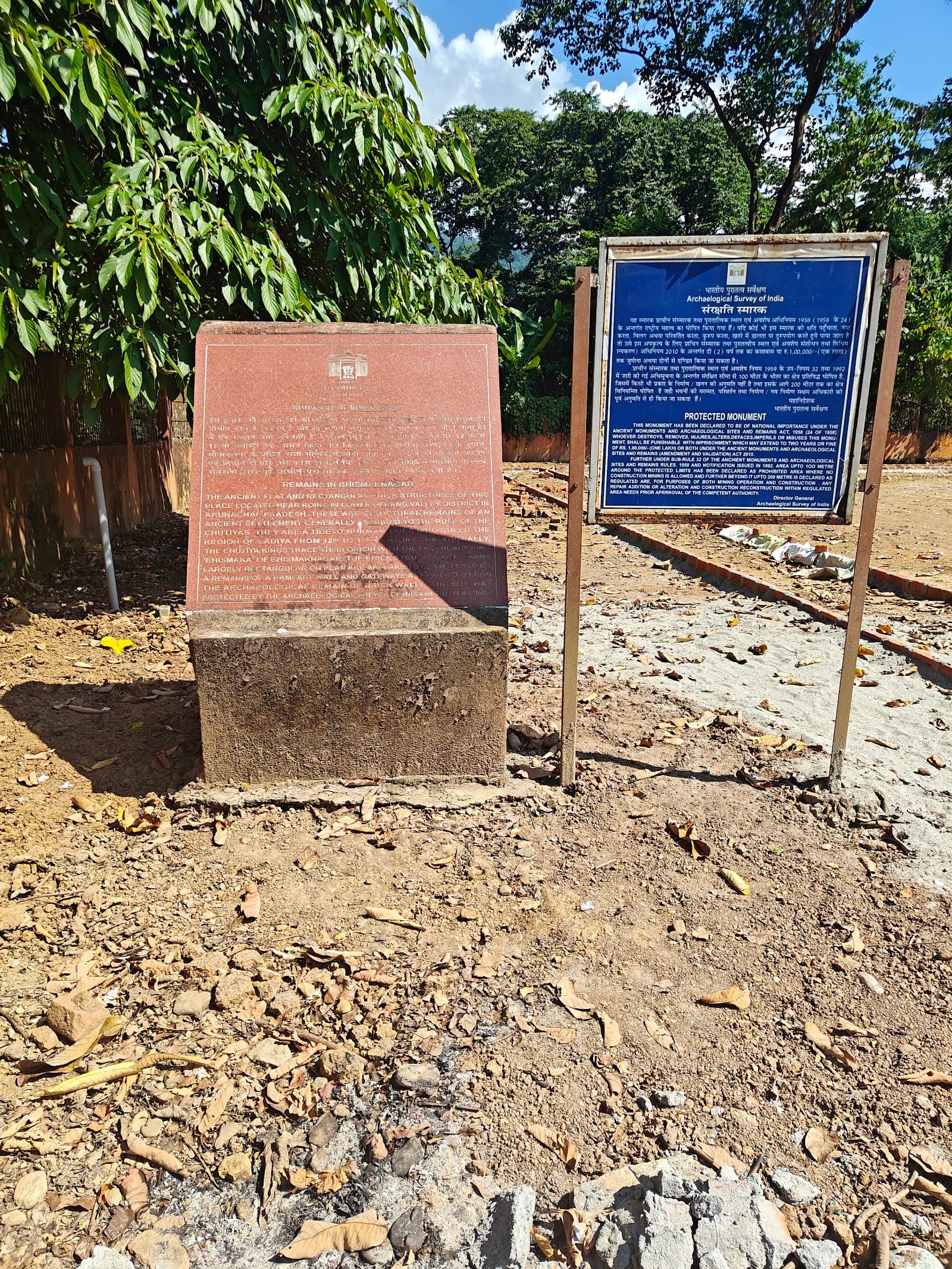
Fired brick and mud brick construction techniques define Bhismaknagar Fort, erected around 1100 CE by the Chutia kingdom in Arunachal Pradesh ([1][2]). As an archaeological site in Khatan, Lower Dibang Valley, Roing, it represents a significant example of Tai Ahom architectural influence ([3]). Archaeological excavations have uncovered a sophisticated, sprawling complex, revealing the architectural prowess of this medieval kingdom ([4]). The fort's rectangular layout features ramparts and gateways, constructed primarily from brick, showcasing the ingenuity of the builders ([5]). Intricate carvings adorning the walls display geometric and floral motifs, reflecting the cultural richness of the Chutia kingdom ([2]). Unlike typical stone fortifications, Bhismaknagar utilized locally abundant clay, crafting large bricks without mortar ([1][5]). Stone platforms and foundations demonstrate a planned construction, hinting at residential and administrative functions ([3][4]). The use of burnt brick, stone, timber, and bamboo highlights the resourcefulness of the builders ([1][2][3]). During the Ahom Period, temple architecture, though not fully evident in Bhismaknagar's ruins, likely influenced the fort's design ([5]). The architectural style incorporates elements of medieval design, with a focus on functionality and defense ([3][4]). Vastu Shastra principles, the ancient Indian science of architecture, may have guided the layout and orientation of the fort, although specific textual references are not available ([5]). Bhismaknagar offers a glimpse into a forgotten era, a testament to the resilience and artistry of its creators ([1]). Bhismaknagar remains a significant archaeological site, linking us to India's diverse heritage ([2][3]). Further research and preservation efforts are crucial to understanding the full scope of its historical and architectural importance ([1][4]). The site stands as a reminder of the Chutia kingdom's legacy and their contribution to the region's cultural landscape ([2][5]).
Kumbhalgarh Fort Rajsamand
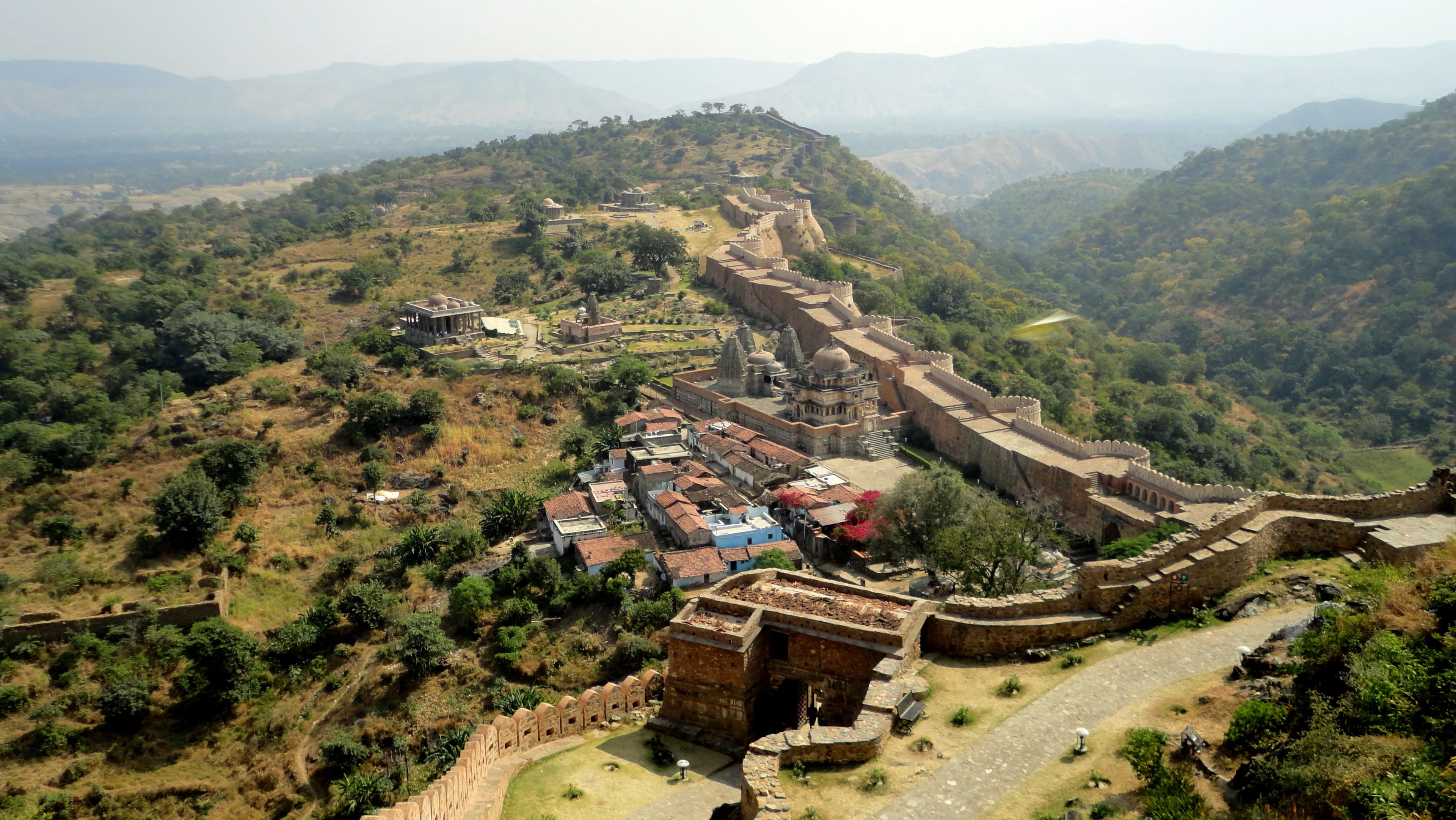
The wind whipped around me, carrying whispers of history as I stood atop Kumbhalgarh Fort, the formidable sentinel of the Aravalli range. Stretching as far as the eye could see, the ramparts snaked across the mountaintops, a testament to Rana Kumbha's ambition and the architectural prowess of the 15th century. They say the wall is so thick that eight horses could ride abreast along it – and having walked a section myself, I can readily believe it. The sheer scale is breathtaking. It's no wonder they call it the "Great Wall of India." My visit began at the main gate, Aret Pol, a sturdy structure bearing the scars of numerous sieges. The intricate carvings, though worn by time and weather, still spoke of a rich artistic tradition. Passing through the gate felt like stepping back in centuries, leaving the modern world behind. The climb to the top was steep, the sun beating down mercilessly, but the anticipation spurred me on. Within the fort's embrace lies a complex network of palaces, temples, and gardens. The Badal Mahal, or Cloud Palace, perched at the highest point, offered panoramic views of the surrounding landscape. From this vantage point, I could appreciate the strategic brilliance of the fort’s location. The undulating hills and dense forests would have provided ample warning of approaching armies, making Kumbhalgarh a near-impregnable fortress. The architecture within the fort is a fascinating blend of Rajput and Mughal influences. The jharokhas, or overhanging balconies, are exquisitely carved, offering glimpses of the intricate latticework within. I noticed the recurring motif of the sun and the lotus flower, symbols of power and purity respectively. The palaces, while grand, also possess a certain understated elegance. The use of local stone and the integration of the natural landscape into the design create a sense of harmony and balance. One of the most striking features of Kumbhalgarh is the sheer number of temples within its walls. From the small, almost hidden shrines to the larger, more elaborate structures, they represent a vibrant spiritual life that thrived within the fort's protective embrace. The Neelkanth Mahadev Temple, with its massive Shiva lingam, is particularly impressive. The intricate carvings on the pillars and ceilings are a testament to the skill of the artisans who worked on them. Beyond the grand palaces and temples, I was equally captivated by the smaller details: the worn steps leading to hidden chambers, the remnants of frescoes on the walls, the strategically placed water tanks that sustained life within the fort during sieges. These details offer a glimpse into the daily lives of the people who once inhabited this magnificent structure – the royalty, the soldiers, the artisans, and the common folk. My visit to Kumbhalgarh wasn't just about admiring the architecture and the breathtaking views. It was about connecting with the past, feeling the weight of history, and imagining the lives lived within these ancient walls. The echoes of battles fought, of celebrations held, of empires risen and fallen, seemed to permeate the very stones of the fort. As I descended, leaving the fort behind, I carried with me not just photographs and memories, but a deeper understanding of Rajasthan's rich and complex heritage. Kumbhalgarh is more than just a fort; it's a living testament to human ingenuity, resilience, and the enduring power of the past.
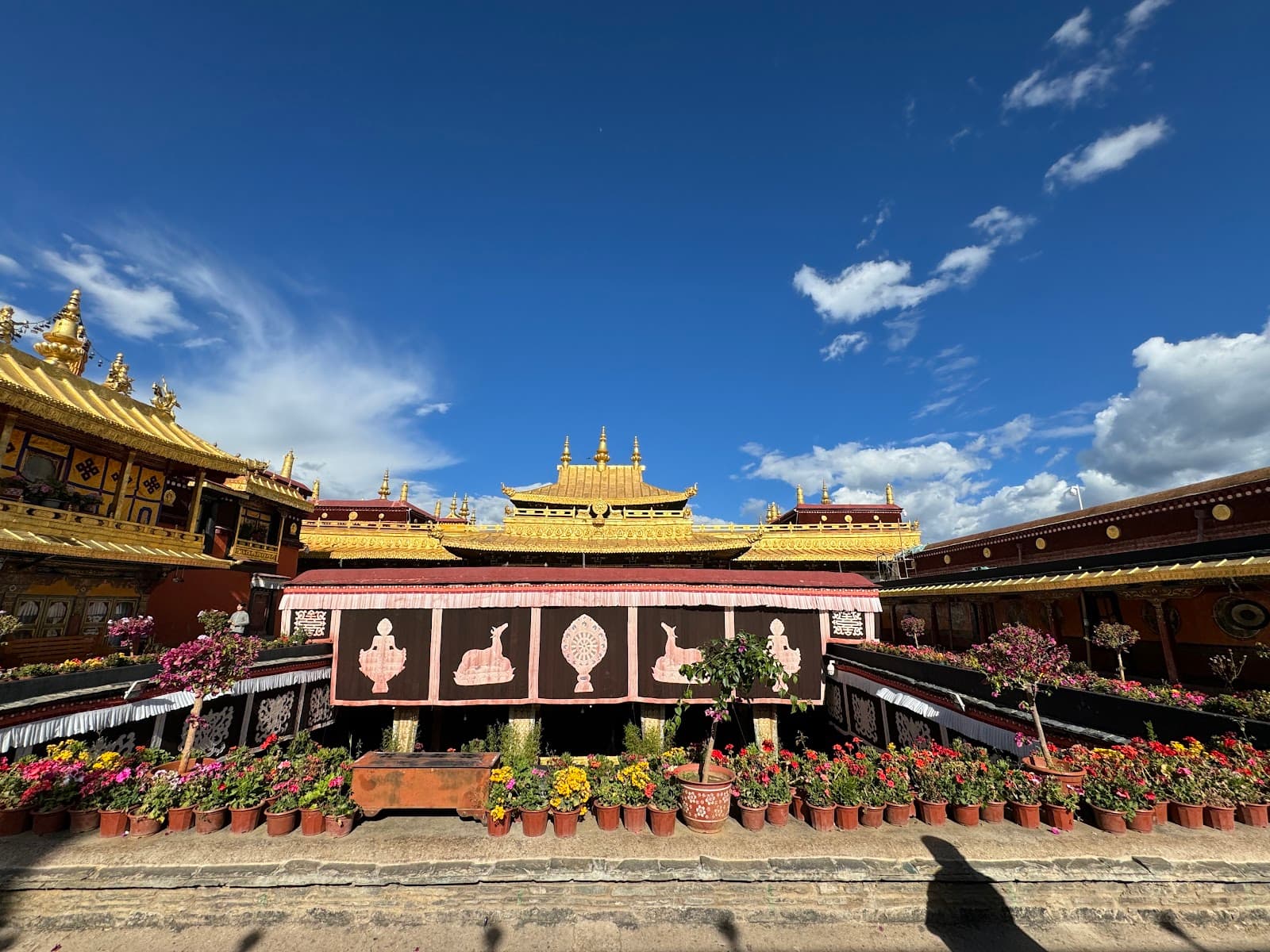
Ramoche Temple Lhasa Tibet
Ramoche Temple, located in Lhasa, Tibet, represents one of the most important Buddhist temples in Tibet, constructed in the 7th century CE during the reign of King Songtsen Gampo and housing the revered Jowo Mikyö Dorje statue, demonstrating the profound transmission of Indian Buddhist traditions to Tibet, which has maintained deep cultural, religious, and historical connections with India for over two millennia. The temple, originally constructed to house the Jowo Mikyö Dorje statue brought from India by King Songtsen Gampo’s Chinese queen Wencheng, features architectural design that synthesizes Indian vihara architecture, Nepalese temple styles, and Tibetan construction techniques, creating a unique architectural expression that reflects Tibet’s position as a cultural bridge between India and Central Asia. The temple complex, constructed primarily from stone and wood with extensive decorative elements, features a multi-story structure with numerous chapels and shrines that have served as centers of Buddhist worship and learning for over thirteen centuries. The temple’s architectural design demonstrates direct influence from Indian Buddhist vihara architecture, particularly the Gupta and Pala period styles, with the overall plan reflecting mandala-based cosmological principles found in Indian temple architecture. Archaeological and historical evidence indicates the temple was constructed with the assistance of Indian and Nepalese architects and craftsmen, reflecting the active religious and cultural exchange between Tibet and India during the 7th century, when Indian Buddhist scholars, texts, and artistic traditions were systematically introduced to Tibet. The temple has undergone multiple renovations and reconstructions over the centuries, with significant work conducted following damage, while preserving its connection to Indian Buddhist traditions. Today, Ramoche Temple continues to serve as an important place of Buddhist worship in Lhasa, demonstrating the enduring vitality of Tibetan Buddhism and its deep roots in Indian religious and cultural traditions. ([1][2])
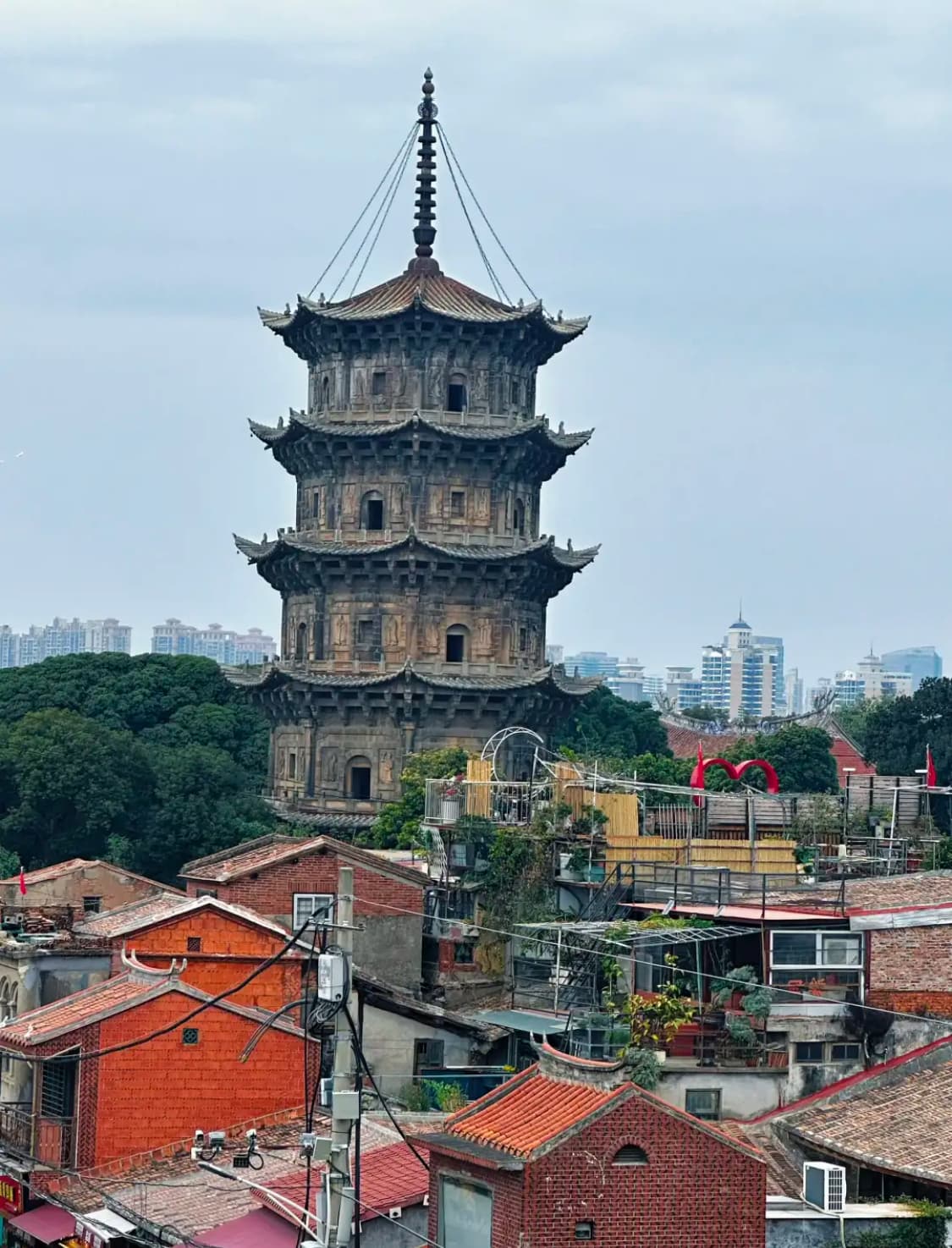
Kaiyuan Temple Quanzhou Fujian China
Kaiyuan Temple, dramatically situated in the historic city of Quanzhou in southeastern Fujian Province, represents one of the most extraordinary and archaeologically significant Buddhist temple complexes in China, dating from the 7th century CE and serving as a major center along the Maritime Silk Road that flourished as a cosmopolitan hub where Indian Hindu and Buddhist traditions, Chinese cultural influences, and Southeast Asian maritime cultures converged, creating a powerful testament to the profound transmission of Indian religious civilization to China during the medieval period. The site, featuring sophisticated Buddhist temple structures with the remarkable preservation of ancient Hindu stone columns that demonstrate clear connections to the architectural traditions of ancient India, particularly the sophisticated column design principles and decorative programs that were transmitted from the great temple centers of southern India, demonstrates the direct transmission of Indian architectural knowledge, religious iconography, and cultural concepts from the great centers of ancient India, particularly the sophisticated temple architecture traditions that were systematically transmitted to China through the extensive maritime trade networks that connected India with China, while the site's most remarkable feature is its extraordinary collection of ancient Hindu stone columns, originally from a Hindu temple that once stood on the site, featuring sophisticated carvings of Hindu deities, mythological scenes, and architectural elements that demonstrate remarkable parallels with Indian temple architecture traditions, particularly the structural techniques and decorative programs that were central to Indian temple architecture. The temple structures' architectural layout, with their sophisticated planning, central halls surrounded by subsidiary structures, and the integration of Hindu architectural elements into Buddhist temple design, follows planning principles that demonstrate remarkable parallels with Indian temple planning principles, particularly the structural techniques and decorative traditions that were central to Indian temple architecture, while the site's extensive archaeological remains including the Hindu stone columns, Buddhist sculptures, and architectural elements demonstrate the sophisticated synthesis of Indian Hindu and Buddhist iconography and cosmological concepts with local Chinese aesthetic sensibilities and building materials. Archaeological evidence reveals that the site served as a major center of religious activity and cultural exchange during the 7th through 13th centuries, attracting traders, monks, and pilgrims from across China, South Asia, and Southeast Asia, while the discovery of numerous artifacts including the Hindu stone columns with clear Indian stylistic influences, Buddhist sculptures that reflect Indian iconographic traditions, and architectural elements that reflect Indian architectural concepts provides crucial evidence of the site's role in the transmission of Indian religious traditions to China, demonstrating the sophisticated understanding of Indian temple architecture and religious practices possessed by the site's patrons and religious establishment. The site's association with the ancient city of Quanzhou, which flourished as a major trading port along the Maritime Silk Road with extensive connections to India and Southeast Asia, demonstrates the sophisticated understanding of Indian religious traditions that were transmitted to China, while the site's Hindu stone columns and Buddhist temple structures demonstrate remarkable parallels with Indian temple architecture traditions that were central to ancient Indian civilization. The site has been the subject of extensive archaeological research and conservation efforts, with ongoing work continuing to reveal new insights into the site's sophisticated architecture, religious practices, and its role in the transmission of Indian religious traditions to China, while the site's status as part of the Quanzhou UNESCO World Heritage Site demonstrates its significance as a major center for the transmission of Indian religious and cultural traditions to China. Today, Kaiyuan Temple stands as one of the most important religious sites in China, serving as a powerful testament to the transmission of Indian religious civilization to China, while ongoing archaeological research and conservation efforts continue to protect and study this extraordinary cultural treasure that demonstrates the profound impact of Indian civilization on Chinese religious and cultural development. ([1][2])
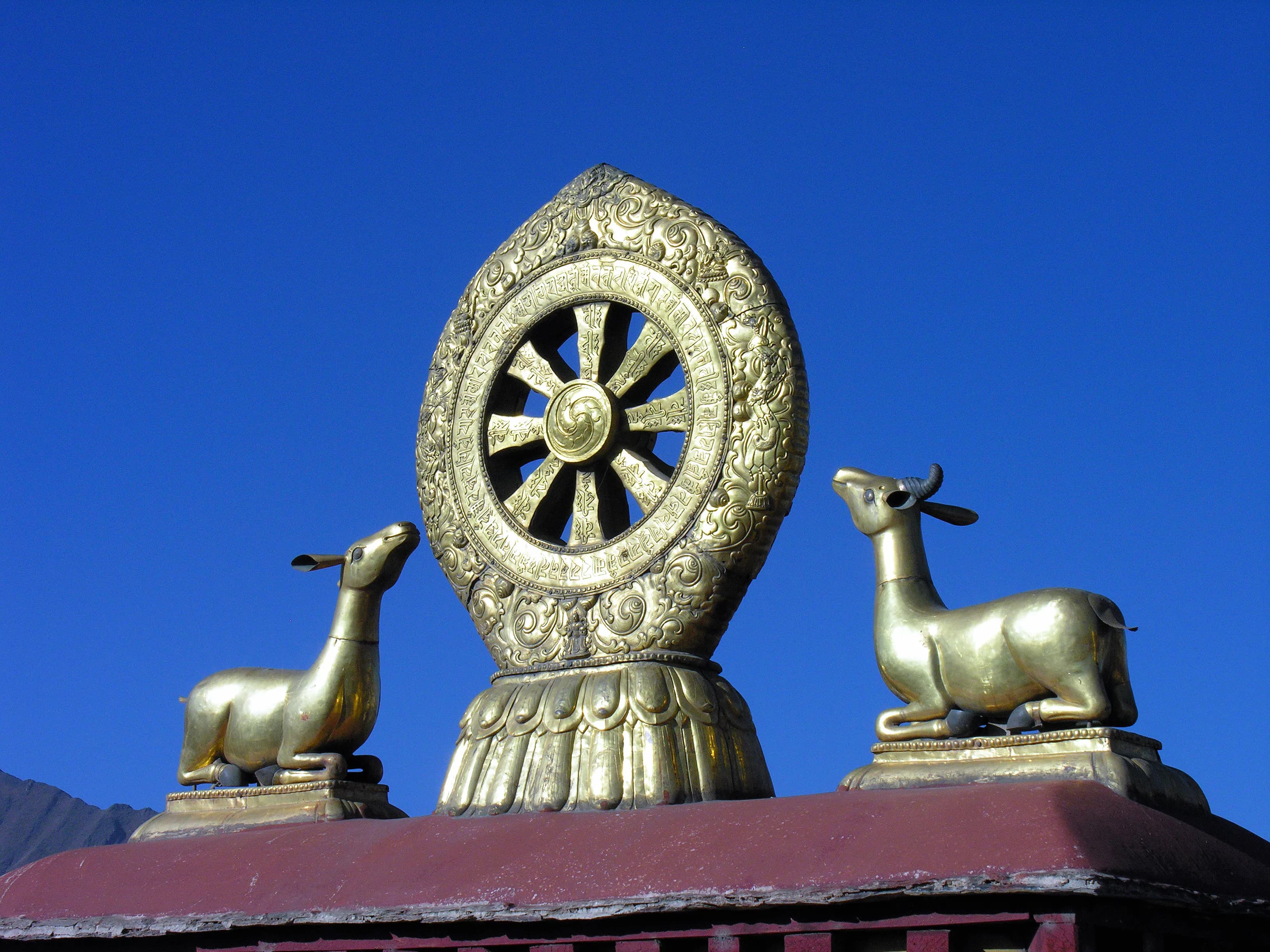
Jokhang Temple Lhasa
The air crackled with a palpable energy, a blend of incense smoke, chanting monks, and the hushed reverence of pilgrims. Jokhang Temple, nestled in the heart of Lhasa, isn't just a building; it's a living, breathing entity, pulsating with the spiritual heart of Tibetan Buddhism. My lens, accustomed to the intricate carvings of South Indian temples and the Mughal grandeur of Rajasthan, struggled to capture the essence of this place, a place where faith seemed etched into the very stones. The first thing that struck me was the sheer density of the experience. The Barkhor Square, which encircles the temple, was a swirling kaleidoscope of colour and movement. Pilgrims, some having travelled for weeks, prostrated themselves before the entrance, their foreheads touching the worn flagstones, a testament to centuries of devotion. The aroma of yak butter lamps mingled with the earthy scent of burning juniper, creating an olfactory landscape as unique as the visual one. Entering the temple complex felt like stepping back in time. The architecture, a fascinating blend of Tibetan, Chinese, Indian, and Nepalese styles, spoke of a rich history of cultural exchange. The weathered wooden beams, darkened by centuries of incense smoke, supported a multi-tiered roof adorned with golden dharma wheels and mythical creatures. Every corner, every doorway, every statue seemed imbued with a story waiting to be told. I focused my camera on the intricate details: the vibrant thangkas depicting scenes from the Buddha's life, the elaborately carved prayer wheels spun rhythmically by devotees, the flickering butter lamps casting dancing shadows on the faces of ancient deities. The main assembly hall, dimly lit and filled with the murmur of prayers, housed the Jowo Shakyamuni statue, the most sacred object in Tibetan Buddhism. Photography was restricted inside, but the image of the jewel-encrusted Buddha, serene and compassionate, remained etched in my memory. As I climbed to the rooftop, the panoramic view of Lhasa unfolded before me. The Potala Palace, perched majestically on Red Mountain, dominated the skyline, a symbol of both religious and political power. From this vantage point, I could appreciate the strategic location of Jokhang Temple, the spiritual nucleus around which the city had grown. The rooftop also offered a closer look at the temple's unique architectural features. The golden roofs, adorned with intricate carvings and topped with golden deer flanking the dharma wheel, shimmered in the afternoon sun. The colourful prayer flags, strung between the rooftops, fluttered in the wind, carrying prayers and blessings to the heavens. Descending back into the labyrinthine corridors of the temple, I found myself drawn to the faces of the pilgrims. Their weathered skin, etched with the hardships of life on the Tibetan plateau, radiated a profound sense of peace and devotion. Their eyes, focused on the sacred images, held a depth of faith that transcended language and culture. My time at Jokhang Temple was more than just a photographic assignment; it was a spiritual journey. It was a privilege to witness the unwavering faith of the Tibetan people and to document a place where the tangible and intangible heritage of a culture converge. As I left the temple, the chanting of the monks still resonated in my ears, a reminder of the enduring power of faith and the timeless beauty of Jokhang Temple. My photographs, I hoped, would capture not just the architectural splendor of the site, but also the profound spiritual energy that permeates every corner of this sacred space.
Quick Links
Plan Your Heritage Journey
Get personalized recommendations and detailed visitor guides